

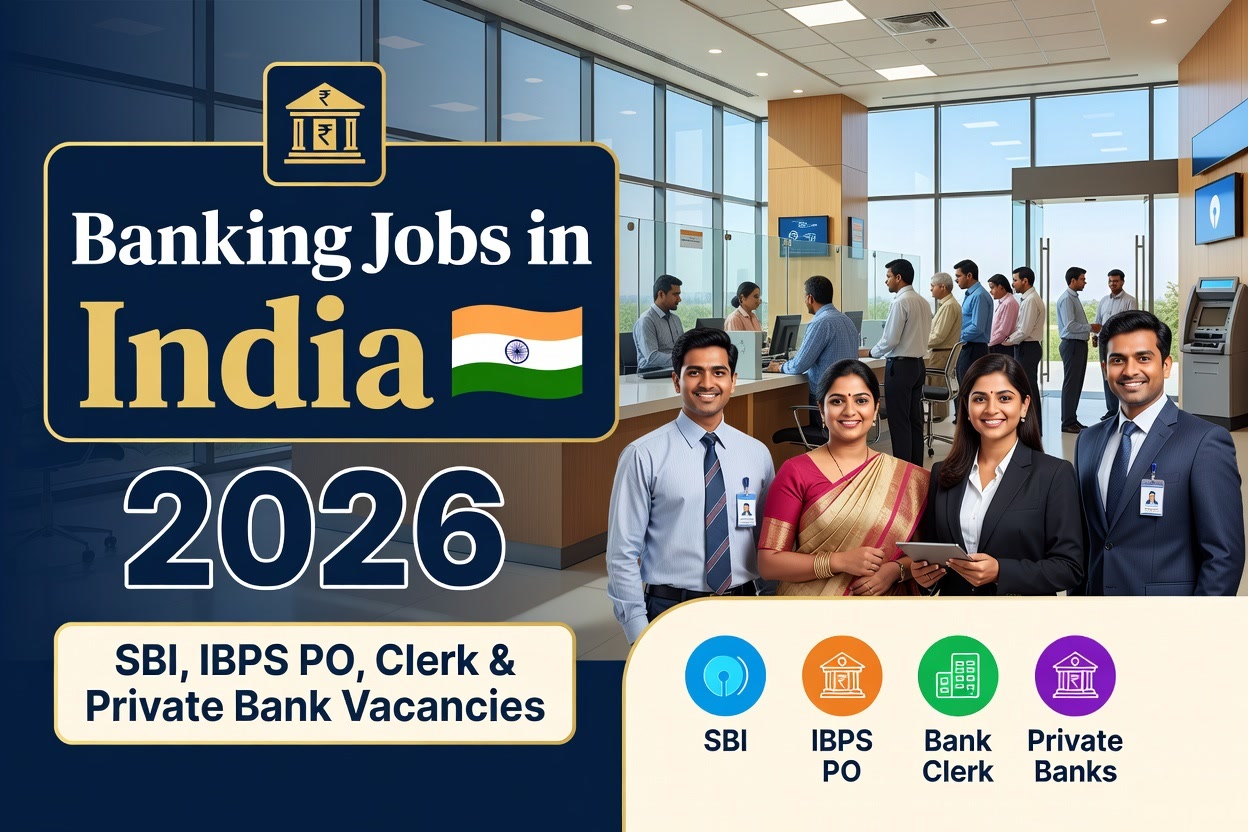
Public sector and private banking job vacancies across India are expected through 2026 for Probationary Officers, Clerks (Customer Service Associates), Regional Rural Bank staff and Specialist Officers. Branch postings are spread across every state, with heavy hiring in Uttar Pradesh, Maharashtra, Karnataka, Tamil Nadu, Gujarat, Rajasthan, West Bengal and Bihar.
These roles suit graduates in any subject who are good with numbers and customers. Public sector banks pay as per the bank-level wage settlement with DA, HRA, medical cover, concessional staff loans and pension, while private banks add performance incentives to a fixed salary.
This guide explains the salary, eligibility, bank exam routes, documents and step-by-step application method for banking jobs in India in 2026.
Banking Jobs in India 2026 — SBI, IBPS PO, Clerk & Private Banks
Officer and clerk posts in public sector, regional rural and private banks. Graduates can apply — public bank posts through official exams only.
Quick Summary
Below is a quick snapshot of banking jobs in India — posts, in-hand salary, exams and what you need to apply — followed by the full details.
Monthly Salary
Public sector bank figures are typical starting in-hand pay after deductions. A clerk starts on ₹24,050 basic and a PO on ₹48,480 basic under the current bank wage settlement, with DA, HRA and special allowance added. Private bank pay varies by city and target. Confirm the exact figure in your appointment or offer letter before joining.
Salary by Type of Bank
Banking jobs in India come from different kinds of banks. Selection method and pay differ between them:
| Bank Type | Typical Posts & Monthly In-hand Pay |
|---|---|
| 🏛️ State Bank of India (SBI) | Junior Associate (Clerk), PO — ₹34,000 – ₹65,000 |
| 🏦 Nationalised banks (IBPS) | Clerk, PO, Specialist Officer — ₹30,000 – ₹60,000 |
| 🌾 Regional Rural Banks (IBPS RRB) | Office Assistant, Officer Scale I — ₹26,000 – ₹48,000 |
| 🏢 Private banks (HDFC, ICICI, Axis) | Relationship Executive, Teller, Branch Officer — ₹18,000 – ₹40,000 |
| 📈 RBI & NABARD | RBI Assistant, Grade B, NABARD Grade A — ₹45,000 – ₹85,000 |
Living Costs at a Branch Posting
A single new bank employee’s typical monthly costs in a district town — so you can see what you keep from your salary:
Public sector bank officers get a leased flat or HRA, which covers most of the rent. Rural postings are cheaper to live in, so new officers save more there.
What Do Bank Employees Do?
- Open savings and current accounts and complete KYC with Aadhaar and PAN.
- Handle cash deposits, withdrawals and cheque clearing at the counter.
- Update passbooks and help customers with net banking, UPI and ATM cards.
- Process home, vehicle, education, Mudra and Kisan Credit Card loans as officers.
- Sell deposits, insurance and government schemes like PMJDY, APY and PMJJBY.
- Follow up on loan repayments and NPAs as a branch officer.
- Follow RBI rules, KYC norms and the bank’s audit checks every day.
Why Choose Banking Jobs in India?
Your Career Growth Path
Banking has a clear promotion ladder — many general managers joined as clerks or POs:
Officer (Scale I)→
Manager (Scale II)→
Branch Manager→
Chief Manager→
AGM / GM
Skills That Help You Get Hired
Who Can Apply — Eligibility
Each bank exam has its own rules, but the realistic eligibility checklist for banking jobs looks like this:
| Criterion | Requirement |
|---|---|
| Age | 20 – 28 years for Clerk and 20 – 30 years for PO, with relaxation for OBC, SC, ST, PwBD and ex-servicemen; private banks usually up to 28 |
| Education | Graduate in any discipline from a recognised university; final-year students can apply where the notice allows |
| Experience | Not needed for Clerk and PO; Specialist Officer posts may ask for work experience |
| Language | Clerk posts need reading, writing and speaking the official language of the state you apply for |
| Exam | IBPS PO, Clerk or RRB, SBI PO or Clerk — prelims, mains and interview for officers |
| Background check | Clean CIBIL record (bank rule) and character verification before joining |
| Documents | Aadhaar, PAN, degree marksheets, category certificate, photo |
Documents Commonly Required
- Aadhaar card and PAN card.
- Graduation degree or provisional certificate with all marksheets.
- 10th certificate for date of birth.
- Caste, EWS or PwBD certificate in the official format, if claiming reservation.
- Recent photograph, signature, thumb impression and handwritten declaration scans.
- CIBIL report — banks check your credit history before joining.
- Bank account details for salary credit.
Note: Public sector bank posts are filled only through IBPS, SBI or RBI notifications and exams, and the only payment is the official exam fee on the official portal. Anyone promising a bank job for money, or a “backdoor” PO post, is a fraud. Genuine private banks also never ask for a joining fee.
Step-by-Step: How to Apply
Ready to apply?
Get bank job alerts and help preparing your application — never pay an agent for a bank job.
Common Mistakes to Avoid
- Ignoring a poor CIBIL record — it can stop your joining even after selection.
- Choosing a state for Clerk without knowing its local language.
- Uploading a wrong thumb impression or handwritten declaration.
- Preparing only maths and skipping banking and current affairs.
- Paying a “placement agent” for a public sector bank job.
Common Interview Questions
- Why do you want to become a bank officer?
- What is the repo rate and who decides it?
- How would you explain UPI to a first-time customer in a village?
- What is an NPA and why does it matter for a bank?
- Are you ready for a rural posting in your first years?
Frequently Asked Questions
What is the salary of a bank PO in 2026?
Is there any fee to apply for bank jobs?
Can a B.Com or B.Sc graduate apply for IBPS PO?
What is the Local Language Proficiency Test?
Is a private bank job better than a public sector bank job?
Conclusion
Banking jobs in India suit graduates who are good with numbers and people, with secure pay in public sector banks and quick hiring in private banks. Prepare for the IBPS and SBI exams, apply only on the official portal, and never pay anyone for a job.
