

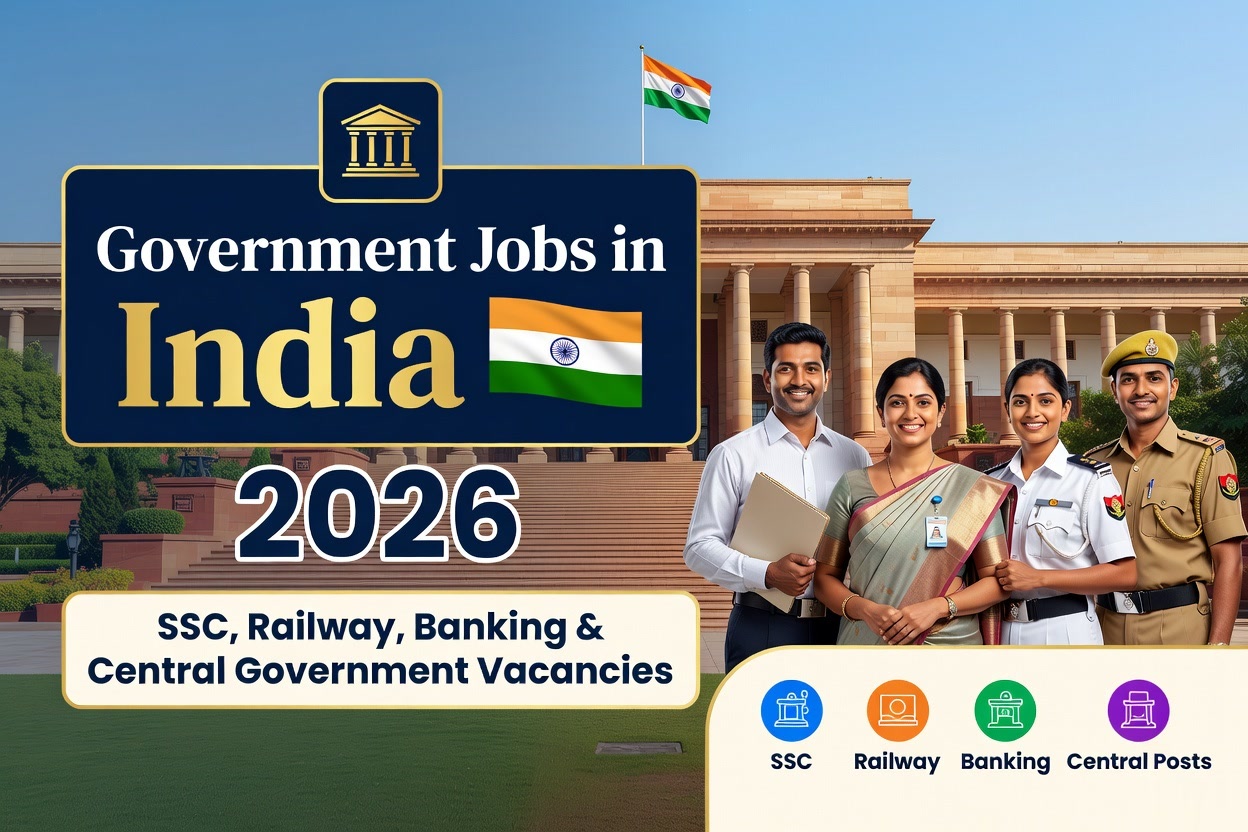
New government job vacancies across India are expected through 2026 from the SSC, Railway Recruitment Boards, IBPS, SBI, UPSC and central armed police forces. Exam centres and postings cover every state, with large intakes in Uttar Pradesh, Bihar, Rajasthan, Madhya Pradesh, Maharashtra, Delhi, West Bengal and Tamil Nadu.
These posts suit 10th pass, 12th pass and graduate candidates who are ready to prepare for a written exam. Selected staff get a fixed pay level, DA, HRA, travel allowance, medical cover, paid leave and a pension under NPS or UPS, along with strong job security.
This guide explains the salary, eligibility, exam routes, documents and step-by-step application method for government jobs in India in 2026.
Government Jobs in India 2026 — SSC, Railway, Banking & Central Posts
Permanent central government posts filled through official exams. 10th, 12th and graduate candidates can apply — no agent or fee beyond the exam fee.
Quick Summary
Below is a quick snapshot of government jobs in India — exams, pay levels, eligibility and what you need to apply — followed by the full details.
Monthly Salary
Figures are 7th Pay Commission starting basic pay. DA, HRA and transport allowance are added on top, so the gross monthly amount is much higher, and HRA depends on the city of posting. Confirm the exact pay level in the official notification and your appointment letter before joining.
Salary by Recruiting Body
Most central government jobs come through a few big recruiting bodies. The posts and starting pay differ between them:
| Recruiting Body | Typical Posts & Starting Basic Pay |
|---|---|
| 📝 SSC (Staff Selection Commission) | MTS, LDC, Tax Assistant, Inspector — ₹18,000 – ₹47,600 |
| 🚆 RRB (Railway Recruitment Boards) | Group D, ALP, Ticket Clerk, Station Master — ₹18,000 – ₹35,400 |
| 🏦 IBPS / SBI (public sector banks) | Clerk, PO, Specialist Officer — ₹24,050 – ₹48,480 basic |
| 🛡️ Central armed police (CISF, CRPF, BSF) | Constable GD, Head Constable, SI — ₹21,700 – ₹35,400 |
| 🏢 UPSC | IAS, IPS, IRS, EPFO officer, Assistant Commandant — ₹47,600 – ₹56,100 |
Living Costs in a Posting City
A single new central government employee’s typical monthly costs in a mid-sized city — so you can see what you keep from your salary:
HRA is paid at a higher rate in big cities, which covers most of the rent. Many departments also offer government quarters at a low licence fee.
What Do Central Government Employees Do?
- Handle files, records, data entry and letters in ministries and central offices.
- Collect and check taxes as Tax Assistants and Inspectors in CBIC and CBDT offices.
- Run train services, ticket counters and station operations in Indian Railways.
- Serve customers, handle cash and approve loans in public sector banks.
- Guard airports, metro stations, borders and industrial units as CAPF personnel.
- Sort and deliver mail and run savings schemes as Postal Assistants.
- Follow government rules, office procedures and the code of conduct at all times.
Why Choose Government Jobs in India?
Your Career Growth Path
Government service has fixed promotion steps — many senior officers joined at the clerk level:
Assistant→
Senior Assistant→
Section Officer→
Under Secretary
Skills That Help You Get Hired
Who Can Apply — Eligibility
Each exam has its own rules, but the common eligibility checklist for central government jobs looks like this:
| Criterion | Requirement |
|---|---|
| Age | 18 – 27 years for most Group C posts, up to 30 – 32 for officer posts; relaxation for OBC, SC, ST, PwBD and ex-servicemen |
| Education | 10th pass for MTS and Constable; 12th pass for LDC and clerk; graduate for Inspector, PO and officer posts |
| Experience | Not needed for most posts; selection is by exam merit |
| Language | Hindi or English for the exam; local language test for some bank and state-zone posts |
| Exam | Computer-based test by SSC, RRB, IBPS, SBI or UPSC, plus skill, typing or physical test where needed |
| Medical / Background | Medical fitness for police and railway posts; police verification of character before appointment |
| Documents | Aadhaar, marksheets, caste or EWS certificate, photo and signature |
Documents Commonly Required
- Aadhaar card for online registration.
- 10th certificate for date of birth proof.
- 12th and graduation marksheets (as applicable to the post).
- Caste, EWS or PwBD certificate in the official format, if claiming reservation.
- Recent passport-size photograph and scanned signature.
- Domicile certificate — for state-zone posts where asked.
- Valid email ID and mobile number for exam alerts.
Note: Only the official exam fee is paid, and only on the official portal of the recruiting body. Anyone promising a government job, a “setting” or a sure selection for money is a fraud — report them to the police.
Step-by-Step: How to Apply
Ready to apply?
Get job alerts and help preparing your application — never pay an agent for a government job.
Common Mistakes to Avoid
- Paying an agent or “coaching contact” who promises a seat.
- Missing the last date because you waited for the final day.
- Uploading a blurred photo or wrong signature, which gets the form rejected.
- Claiming a category without a valid certificate in the right format.
- Applying without reading the age and qualification rules for each post.
Common Interview Questions
- Why do you want a government job?
- Which department or post do you prefer, and why?
- What do you know about the work of the ministry or office you applied for?
- Are you ready for a transfer to any part of India?
- How do you handle pressure and deadlines at work?
Frequently Asked Questions
Which government job is best after 12th?
Is there any fee to apply?
Can 10th pass candidates get central government jobs?
What is DA and how does it change?
Will the 8th Pay Commission change these salaries?
Conclusion
Government jobs in India offer secure pay, regular raises and a pension for 10th pass, 12th pass and graduate candidates. Pick the right exam, prepare steadily, apply only on the official portal, and never pay anyone for a job.
